
How to Lose Weight at Home in 2026: No Gym, No Gimmicks, No Excuses
You do not need a gym membership, expensive equipment, or a personal trainer to lose weight in 2026. What you need is the right information, a realistic plan, and the discipline to start. This guide gives you all three.
Table of Contents
- Why So Many Americans Are Ditching the Gym in 2026
- The Science of Home Weight Loss: What Actually Works
- The Best Home Workouts for Weight Loss (No Equipment Needed)
- How to Build a Weekly Home Workout Schedule
- Nutrition at Home: Eating for Fat Loss Without Obsessing
- Daily Habits That Supercharge Weight Loss
- The Role of Sleep and Stress in Home Weight Loss
- Best Free Apps and Tools to Support Home Weight Loss
- Common Mistakes That Stall Home Weight Loss Progress
- Real Results: How Long Before You Notice a Difference?
- Frequently Asked Questions
1. Why So Many Americans Are Ditching the Gym in
The average gym membership in the United States now costs between $40 and $70 per month — and that is before you factor in gas, parking, commute time, and the psychological friction of showing up to a crowded facility after a long workday. When you add it all up, millions of Americans are asking a perfectly reasonable question: Is the gym actually necessary?
The answer, backed by decades of exercise science, is a firm no.
Some of the most dramatic body transformations happening in the United States right now are taking place in living rooms, backyards, apartment hallways, and spare bedrooms — not commercial gyms. The pandemic-era explosion in home fitness revealed something the fitness industry had long underplayed: for most people’s weight loss goals, controlled movement, consistent effort, and smart nutrition are the variables that matter most. The location is largely irrelevant.
In 2026, the case for home-based weight loss is stronger than ever. Streaming workout platforms, AI-powered fitness coaching, affordable resistance bands, and a flood of evidence-based content have made it possible to build a genuinely effective fitness routine without ever setting foot in a gym.
This guide is built for real people with real schedules — not fitness influencers with four hours a day to train. Whether you have 20 minutes in the morning before the kids wake up or 45 minutes in the evening after dinner, there is a sustainable, effective approach here for you.
2. The Science of Home Weight Loss: What Actually Works
Before diving into specific workouts and meal plans, it is worth grounding everything in the basic science — because the fitness industry is full of contradictory advice, and knowing the fundamentals protects you from wasting months on approaches that do not work.
The Caloric Deficit: The Non-Negotiable Foundation
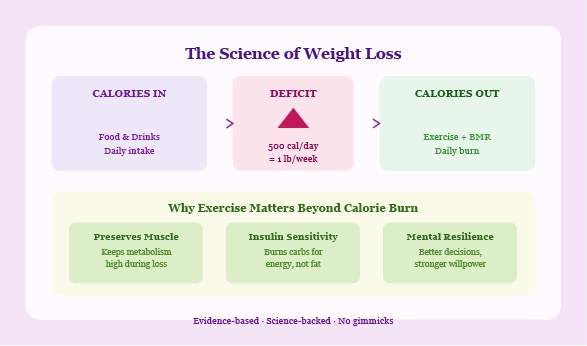
Weight loss, regardless of what any diet trend claims, requires one fundamental condition: you must consistently consume fewer calories than your body burns. This is called a caloric deficit, and it is the bedrock of every weight loss approach that science has validated.
One pound of body fat contains approximately 3,500 calories. To lose one pound per week — a healthy and sustainable rate — you need a daily deficit of roughly 500 calories. This can come from eating less, moving more, or a combination of both. Most people find the combination most sustainable.
A 500-calorie daily deficit can be achieved through:
- 250 calories burned through a 30-minute home workout
- 250 calories removed from daily food intake (roughly one large soda, a handful of chips, or a tablespoon of butter added to three meals)
This math sounds simple because it essentially is. The difficulty is behavioral, not biological.
Why Exercise Matters Beyond Calorie Burn
Many people are surprised to learn that the calorie burn from exercise is actually a relatively small part of why exercise helps with weight loss. A 30-minute walk burns roughly 150–200 calories for the average adult — equivalent to a small snack. The real benefits of consistent exercise for weight loss are:
Muscle preservation: When you lose weight through diet alone, up to 25% of the weight lost can come from muscle mass. Adding resistance training preserves muscle, which keeps your metabolism elevated.
Improved insulin sensitivity: Exercise makes your body more efficient at using carbohydrates for energy rather than storing them as fat.
Appetite regulation: Moderate exercise has been shown to reduce appetite-stimulating hormones in many people, making dietary changes feel less difficult.
Mental resilience: People who exercise consistently report stronger motivation, better mood, and greater self-control in other areas of life — including food choices.
The Metabolism Myth
Many people believe their metabolism is uniquely slow and therefore responsible for their weight gain. While metabolic rate does vary between individuals, research consistently shows the differences are far smaller than most people assume. For the vast majority of adults, unexplained weight gain is explained by gradual increases in caloric intake and gradual decreases in physical activity over time — not a broken metabolism.
The good news: regular exercise, adequate protein intake, and quality sleep are the most effective tools for supporting a healthy metabolic rate — and all three are available to you at home.
3. The Best Home Workouts for Weight Loss (No Equipment Needed)
You do not need a single piece of equipment to burn meaningful calories and build the muscle that accelerates fat loss. The following exercises are among the most effective for home weight loss, ranked by calorie burn, accessibility, and long-term sustainability.
High-Intensity Interval Training (HIIT)
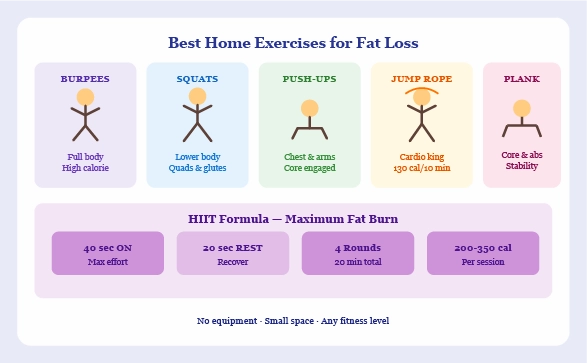
HIIT is the gold standard for home fat burning. The concept is simple: alternate between short bursts of maximum effort and brief recovery periods. This approach creates something researchers call excess post-exercise oxygen consumption (EPOC) — informally known as the “afterburn effect” — where your body continues burning calories at an elevated rate for hours after the workout ends.
A basic 20-minute HIIT session with no equipment:
- Jumping jacks — 40 seconds on, 20 seconds rest
- Burpees — 40 seconds on, 20 seconds rest
- High knees — 40 seconds on, 20 seconds rest
- Squat jumps — 40 seconds on, 20 seconds rest
- Mountain climbers — 40 seconds on, 20 seconds rest
Repeat this circuit four times. At moderate-to-high intensity, this session burns approximately 200–350 calories and can be completed in any space large enough to spread a yoga mat.
Bodyweight Strength Training
Strength training is the most underrated tool for home weight loss. Many people assume it requires weights, but your own body provides substantial resistance — especially when exercises are programmed intelligently.
Key bodyweight exercises for fat loss:
Squats: The single most effective lower body movement. Targets quads, hamstrings, glutes, and core simultaneously. Three sets of 15–20 repetitions is an excellent starting point.
Push-ups: Targets chest, shoulders, triceps, and core. Modify on your knees if needed. Progress to elevated feet push-ups as strength improves.
Lunges: Walking lunges challenge balance, activate the glutes deeply, and burn significantly more calories than static squats. Aim for 12 repetitions per leg.
Glute bridges: Lie on your back with knees bent, feet flat on the floor. Drive your hips toward the ceiling, squeezing your glutes at the top. Excellent for anyone with a desk job and tight hip flexors.
Plank variations: Isometric core work that builds the stability required for all other movements. Standard plank, side plank, and plank-to-shoulder-tap are all valuable.
Superman hold: Lying face down, lift your arms and legs simultaneously and hold. Builds posterior chain strength that protects the lower back.
Walking: The Underrated Fat Burner
Walking is dismissed by many fitness beginners as “too easy” to matter. This is one of the most consequential misconceptions in the weight loss world. Research consistently shows that daily walking is one of the most reliable predictors of long-term weight management success — precisely because it is sustainable, low-injury-risk, and can be integrated into daily life without dedicated workout time.
The goal of 7,000–10,000 daily steps (roughly 3–5 miles) burns between 300–500 additional calories per day for the average adult. Over a week, that is 2,100–3,500 extra calories burned without a single structured workout.
Practical walking strategies for busy Americans:
- Walk during phone calls instead of sitting
- Take a 15-minute walk after each meal (this also significantly improves blood sugar regulation)
- Park farther from entrances habitually
- Take stairs whenever possible
- Replace one evening of screen time with a neighborhood walk
Jump Rope
A jump rope costs under $20 and provides one of the highest calorie-burn-per-minute ratios of any exercise available. Ten minutes of moderate jump rope burns approximately 100–130 calories. Beyond calorie burn, jump rope improves coordination, cardiovascular health, and footwork — benefits that transfer to virtually every other physical activity.
Beginners can start with 30 seconds on, 30 seconds rest for 10 minutes and build from there.
Yoga and Mobility Work
Pure yoga is not a high-calorie-burning activity, but it earns its place in a home weight loss program for three reasons: it reduces the cortisol (stress hormone) that drives fat storage and cravings, it improves mobility that allows more intense workouts, and it builds the mind-body connection that helps people make more conscious food choices.
Adding even two 20-minute yoga sessions per week to a HIIT and strength routine produces measurably better results than exercise alone — because stress is one of the most overlooked drivers of weight gain in busy American adults.
4. How to Build a Weekly Home Workout Schedule
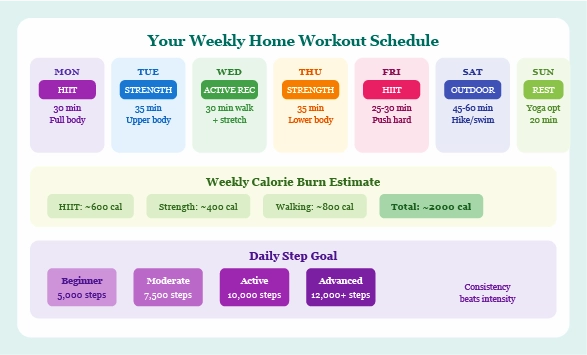
Consistency beats intensity in the long run. A good schedule is one you actually follow — not one that looks impressive on paper but collapses after ten days.
Here is a beginner-friendly weekly home workout schedule that can be completed with zero equipment in 30–45 minutes per session:
Monday — HIIT (30 minutes) Full-body interval training. Burpees, jump squats, mountain climbers, high knees. Push to 70–80% effort during work intervals.
Tuesday — Strength Training: Upper Body (35 minutes) Push-ups (3 sets), tricep dips using a chair (3 sets), plank variations (3 sets), superman hold (3 sets). Rest 60 seconds between sets.
Wednesday — Active Recovery 30-minute walk + 15 minutes of gentle stretching or yoga. This is not a rest day — it is a movement day at reduced intensity. Active recovery reduces soreness and maintains caloric expenditure.
Thursday — Strength Training: Lower Body (35 minutes) Squats (4 sets), reverse lunges (3 sets per leg), glute bridges (3 sets), wall sit (3 x 45 seconds). Add a resistance band around the knees if available.
Friday — HIIT or Jump Rope (25–30 minutes) Push intensity higher than Monday. This is your end-of-week energy release.
Saturday — Long Walk or Outdoor Activity (45–60 minutes) Hiking, cycling, swimming, recreational sport — anything that moves your body for an extended period at comfortable intensity.
Sunday — Full Rest or Yoga (20 minutes) Allow your body to recover. Muscle repair happens during rest, not during exercise. Skipping rest days is one of the most common mistakes beginners make.
This six-day structure burns approximately 1,500–2,500 calories per week through structured exercise alone — an excellent foundation for consistent weight loss when combined with dietary awareness.
5. Nutrition at Home: Eating for Fat Loss Without Obsessing
No workout program can fully compensate for poor nutrition. The popular saying “abs are made in the kitchen” is slightly oversimplified, but it contains an important truth: your food choices have a far greater impact on your body composition than your exercise choices.
The good news: effective fat-loss nutrition is not about deprivation, elimination diets, or calorie counting to the decimal point. It is about building a sustainable eating framework that naturally reduces caloric intake while keeping you full, energized, and satisfied.
The Protein Priority
Protein is the single most important macronutrient for home weight loss. It is the most satiating macronutrient (it keeps you fuller for longer than carbohydrates or fat), it requires more energy to digest (increasing caloric burn slightly), and it is essential for preserving muscle mass during weight loss.
The general guideline for active adults pursuing fat loss is 0.7 to 1 gram of protein per pound of body weight per day. For a 160-pound person, that is 112–160 grams daily.
High-protein foods that are affordable and practical for home cooking:
- Chicken breast or thighs
- Eggs (one of the most complete protein sources available)
- Canned tuna and salmon
- Greek yogurt
- Cottage cheese
- Lentils and black beans
- Edamame
- Tofu and tempeh
The Volume Eating Strategy
One of the most practical fat-loss strategies for people who hate feeling hungry is volume eating: prioritizing foods that are large in physical volume but low in calories. This means you eat a genuinely satisfying amount of food while maintaining a caloric deficit.
High-volume, low-calorie foods:
- All leafy greens (spinach, arugula, romaine — roughly 10 calories per cup)
- Cucumber, celery, zucchini
- Watermelon, strawberries, blueberries
- Broth-based soups
- Air-popped popcorn
Building meals around these foods alongside a lean protein source creates plates that feel abundant while supporting fat loss.
Simple Home Meal Framework
Rather than following a rigid diet, use this flexible framework for each meal:
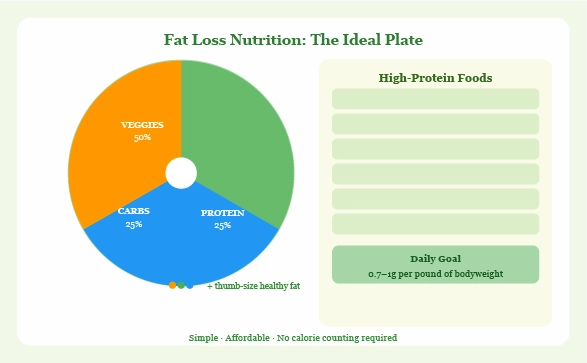
Half your plate: Non-starchy vegetables (any color, any preparation) A quarter of your plate: Lean protein (chicken, fish, eggs, legumes) A quarter of your plate: Complex carbohydrate (brown rice, sweet potato, oats, quinoa) A thumb-sized portion: Healthy fat (olive oil, avocado, nuts)
This framework naturally produces a moderate caloric deficit for most adults without tracking a single calorie. It also ensures adequate micronutrient intake, fiber for gut health, and steady energy throughout the day.
The Three Biggest Nutrition Mistakes at Home
Liquid calories: Sodas, juices, sweetened coffees, and alcohol contribute hundreds of daily calories with essentially no satiety. Switching to water, black coffee, and unsweetened tea as primary beverages is one of the single highest-impact dietary changes most Americans can make.
Mindless snacking: Eating in front of screens disconnects people from hunger and fullness signals, leading to significant overconsumption. Implement a simple rule: eat at a table, without screens, as often as possible.
Weekend abandonment: Many people eat well Monday through Thursday and then consume enough on Friday through Sunday to erase the week’s deficit. A caloric deficit must average out over the full week to produce results.
6. Daily Habits That Supercharge Weight Loss
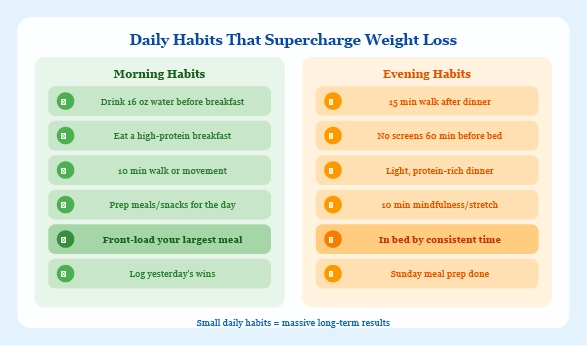
Beyond formal workouts and meal planning, a handful of daily habits have an outsized impact on weight loss outcomes. These are the behaviors that distinguish people who achieve lasting results from those who lose and regain repeatedly.
Drink water before every meal. Research shows that consuming 16 ounces of water 30 minutes before eating reduces caloric intake by approximately 13% at that meal. Do this before every meal and the compound effect across a week is significant.
Front-load your calories. Eating your largest meal earlier in the day — and tapering toward lighter meals in the evening — aligns with your body’s circadian metabolic rhythms and has been associated with greater fat loss compared to the common American pattern of a small breakfast, modest lunch, and large dinner.
Prepare food in advance. Sunday meal prep is one of the highest-return-on-investment health habits available. Spending two hours preparing proteins, chopping vegetables, and cooking grains reduces weekday decision fatigue and eliminates the “too tired to cook, ordering pizza” scenario that derails most weight loss attempts.
Stand more, sit less. Non-exercise activity thermogenesis (NEAT) — the calories burned through everyday movement outside formal workouts — contributes more to total daily energy expenditure than most people realize. Standing at a desk instead of sitting, fidgeting, pacing while on calls, and taking walking breaks all add up meaningfully.
Track your intake at least some of the time. You do not need to count calories forever, but doing so for even two or three weeks gives you an accurate map of where your calories are actually coming from. Most people are genuinely surprised by this data. Free apps like MyFitnessPal or Cronometer make tracking quick and easy.
7. The Role of Sleep and Stress in Home Weight Loss
This section covers what is possibly the most underestimated factor in American weight gain: the chronic combination of poor sleep and elevated stress.
How Sleep Deprivation Drives Weight Gain
When you sleep fewer than seven hours per night, several physiological changes work against your weight loss goals simultaneously:
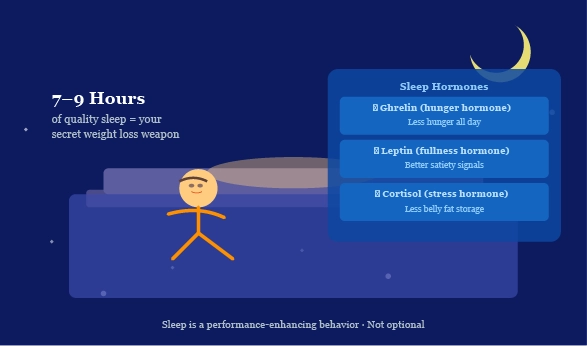
Ghrelin increases. Ghrelin is the hormone that signals hunger. Sleep-deprived individuals produce significantly more of it — meaning they feel genuinely hungrier throughout the day, not just less disciplined.
Leptin decreases. Leptin signals fullness. With less leptin circulating, the brain receives reduced “stop eating” signals, leading to overconsumption even when caloric needs are met.
Cortisol elevates. The stress hormone cortisol directs the body to store fat, particularly in the abdominal area. Chronic sleep deprivation triggers chronic cortisol elevation.
Decision-making deteriorates. Tired people make poorer food choices — not because they lack willpower, but because the prefrontal cortex (responsible for impulse control) is genuinely impaired by sleep loss.
The practical implication: getting seven to nine hours of quality sleep per night is not a luxury. For weight loss purposes, it is a performance-enhancing behavior as impactful as any workout.
Stress, Cortisol, and Belly Fat
Chronic psychological stress — from work, financial pressure, relationship difficulties, or simply the always-on nature of modern American life — produces sustained cortisol elevation that actively promotes fat storage and undermines the hormonal environment needed for fat loss.
This explains why some people who exercise consistently and eat reasonably well still struggle to lose weight: they are chronically stressed, and cortisol is overriding their efforts.
Practical stress management strategies that directly support weight loss:
- Daily 10-minute mindfulness or meditation practice
- Consistent sleep and wake times, even on weekends
- Reducing evening screen exposure (screens suppress melatonin and elevate alertness)
- Walking in nature (shown to reduce cortisol more effectively than walking in urban environments)
- Limiting news and social media consumption to designated windows
>8. Best Free Apps and Tools to Support Home Weight Loss
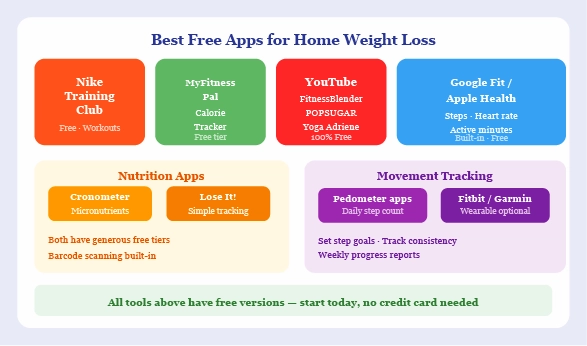
Technology has made home weight loss more structured, measurable, and motivating than ever before. These are the most effective free and low-cost tools available right now:
Nike Training Club — Hundreds of free guided home workouts from beginner to advanced, with no equipment options and clear instruction. One of the most comprehensive free fitness resources available.
MyFitnessPal — The most widely used free food tracking app. Scan barcodes, log meals, and track macros. The free version provides everything most people need.
Cronometer — More detailed nutrient tracking than MyFitnessPal, particularly useful for people focused on micronutrients alongside calories and macros.
Peloton App — Beyond bike classes, Peloton’s app offers floor strength, HIIT, yoga, and meditation content. A free trial unlocks full access to explore.
YouTube (free) — An enormous library of home workout content. Channels like Yoga with Adriene, POPSUGAR Fitness, FitnessBlender, and Sydney Cummings Houdini offer full-length, structured home workout programs at zero cost.
Google Fit / Apple Health — Built-in movement tracking on Android and iOS respectively. Monitor daily step counts, active minutes, and heart rate without any additional apps or devices.
Lose It! — Simplified calorie tracking with a clean interface and meal planning suggestions. The free tier covers core tracking needs.
9. Common Mistakes That Stall Home Weight Loss Progress
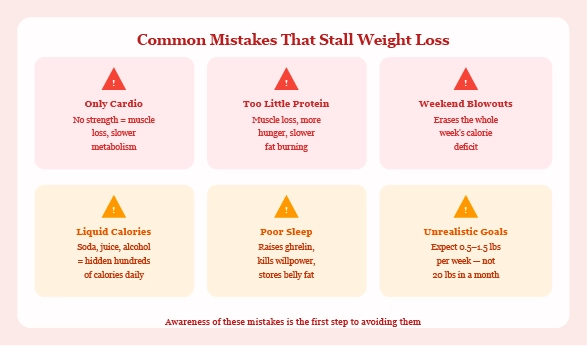
Understanding what derails people is just as important as knowing what works. These are the most common mistakes that cause home weight loss programs to stall or fail:
Doing only cardio. Cardio burns calories but does not build muscle. Muscle is metabolically active tissue — it burns calories even at rest. Without resistance training, weight loss often slows after an initial phase because muscle mass is lost along with fat, depressing the basal metabolic rate.
Not eating enough protein. This is the single most common nutritional mistake. Insufficient protein leads to muscle loss, increased hunger, and slower recovery from workouts — all of which undermine long-term fat loss.
Overestimating calorie burn. Fitness trackers and cardio machines routinely overestimate calorie burn by 20–50%. Many people compensate for a workout by eating more than they actually burned. Do not eat back exercise calories unless you are genuinely very hungry.
Inconsistency. Three amazing workout weeks followed by two weeks off produces far less total progress than seven consistent moderate weeks. Frequency and consistency are more important than intensity.
Ignoring non-scale victories. The scale measures total weight — including water, muscle, food in digestion, and fat. It fluctuates by up to five pounds in a single day based on hydration and sodium alone. People who obsess over daily weigh-ins frequently become demoralized by normal fluctuations and quit. Track measurements, progress photos, energy levels, sleep quality, and clothing fit as additional indicators of progress.
Setting unrealistic timelines. Sustainable fat loss occurs at 0.5–1.5 pounds per week for most people. Someone who expects to lose 20 pounds in six weeks will either fail to achieve it (and feel like a failure) or achieve it through methods so extreme they trigger rebound weight gain. Set a realistic target of 6–8 pounds per month as a healthy upper ceiling.
10. Real Results: How Long Before You Notice a Difference?
This is the question everyone wants answered honestly — and the answer depends on where you start and how consistently you apply these principles.
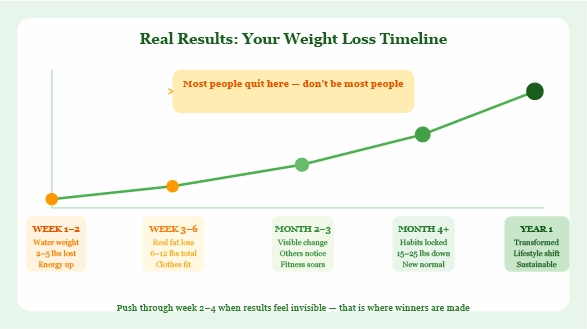
Weeks 1–2: Water weight reduction of 2–5 pounds is common, driven primarily by reduced carbohydrate and sodium intake. Energy levels improve, sleep often gets more restful, and the feeling of taking positive action creates psychological momentum. Visible body composition changes are minimal at this stage.
Weeks 3–6: Fat loss begins to accumulate. One to two pounds of actual fat per week produces a 6–12 pound reduction over this period for consistent followers. Clothes start to fit differently. The workouts become noticeably more manageable as cardiovascular fitness improves.
Months 2–3: Visible changes become undeniable. Friends and family begin commenting. Workout capacity has improved significantly — exercises that were difficult in week one are now comfortable, signaling the need to progress (more reps, longer intervals, more challenging variations).
Month 3 and beyond: This is where the compounding effect of consistent effort becomes transformative. The habits established in the first twelve weeks are no longer forced — they are becoming default behaviors. The metabolic adaptations from sustained exercise are in full effect. Many people in this phase report that the lifestyle changes feel normal rather than effortful.
The most important thing to understand: you will not see dramatic results in the first two weeks. This is where most people quit. The people who push through weeks two through four — when effort is high and visible results are modest — are the ones who achieve the transformations that motivate others.
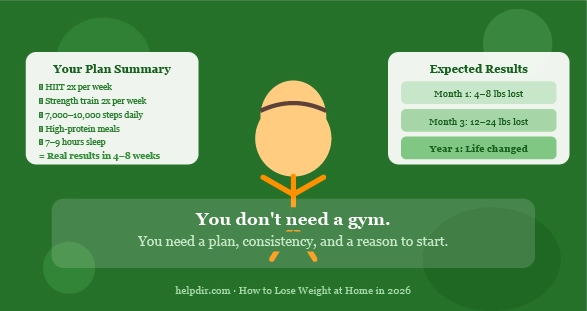
Quick Reference: Home Weight Loss Plan Summary
| Element | Recommendation | Frequency |
|---|---|---|
| HIIT Cardio | 20–30 minutes, bodyweight | 2x per week |
| Strength Training | 30–40 minutes, bodyweight | 2x per week |
| Daily Walking | 7,000–10,000 steps | Daily |
| Active Recovery | Yoga, stretching, light walk | 1–2x per week |
| Protein Intake | 0.7–1g per pound of bodyweight | Daily |
| Water | 64–100 oz depending on size/activity | Daily |
| Sleep | 7–9 hours | Every night |
| Meal Prep | Batch cook proteins & grains | Weekly (Sunday) |
| Stress Management | 10 min mindfulness or walk | Daily |
| Progress Tracking | Photos + measurements + weight | Weekly (same day/time) |
11. Frequently Asked Questions
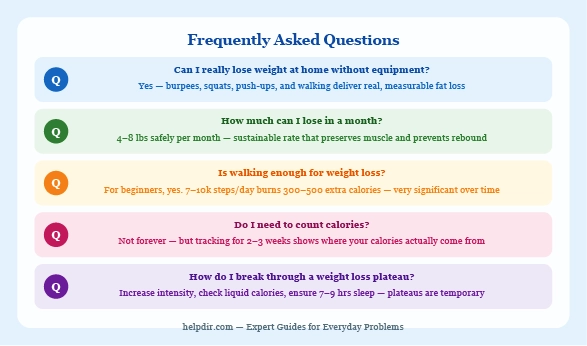
Q: Can I really lose weight at home without any equipment? A: Absolutely. Bodyweight exercises like push-ups, squats, burpees, lunges, and mountain climbers provide sufficient resistance for meaningful muscle building and fat burning. A yoga mat and jump rope (optional, under $20) are the only additions that noticeably expand your options.
Q: How much weight can I realistically lose in a month at home? A: A safe and sustainable rate is 4–8 pounds per month, depending on your starting weight, consistency, and dietary adherence. People with more weight to lose often see faster early results; people closer to their goal weight experience slower but still meaningful progress.
Q: Is walking enough exercise for weight loss? A: For beginners and people with mobility limitations, walking alone — when done consistently and at sufficient volume — can absolutely drive meaningful weight loss. As fitness improves, adding strength training and higher-intensity sessions accelerates results and prevents the metabolic slowdown that can accompany weight loss through cardio alone.
Q: What should I eat before and after a home workout? A: Pre-workout: a small, easily digestible snack with carbohydrates and a little protein 30–60 minutes before exercise. A banana with peanut butter or Greek yogurt with berries works well. Post-workout: prioritize protein within an hour of finishing. A protein shake, eggs, cottage cheese, or chicken are all effective options that support muscle recovery.
Q: How do I break through a weight loss plateau at home? A: Plateaus happen when the body adapts to your current caloric intake and exercise stimulus. Break through by: increasing workout intensity or adding new exercises, slightly reducing caloric intake (by 100–150 calories), adding one additional active day, reassessing liquid calorie intake, and confirming you are getting adequate sleep. Plateaus are normal and temporary — they are not a signal that your body cannot lose more weight.
Q: Do I need to give up alcohol to lose weight at home? A: You do not need to eliminate alcohol entirely, but it is worth understanding its impact. Alcohol adds calories with zero nutritional value, impairs sleep quality, lowers inhibitions around food choices, and temporarily halts fat metabolism while it is being processed. Reducing alcohol consumption — particularly the habit of nightly drinks — is one of the highest-impact changes many adults can make.
Q: Can older adults lose weight effectively with home workouts? A: Yes, with appropriate exercise selection. Adults over 50 benefit enormously from bodyweight strength training (which combats age-related muscle loss), low-impact cardio like walking and cycling, and flexibility work. The principles of caloric deficit and protein priority apply equally. Consulting a physician before beginning a new exercise program is recommended for adults with existing health conditions.
Disclaimer: This article is for informational and educational purposes only. It does not constitute medical advice. Always consult your physician or a qualified healthcare professional before beginning a new exercise or nutrition program, particularly if you have existing health conditions.